INTERNATIONAL REHABILITATION
AND SOIL STABILISATION SERVICES
ENV 311 – Management of Aquatic Systems
Wetland Project Report
Kym Pryor; 30178745
A Comparison of Water Quality Between Two Wetlands of Differing Levels of Disturbance, Located on the Swan Coastal Plain
ABSTRACT:
The study aimed to test whether a well managed wetland (Tomato Lake) that was highly disturbed from its original state had better water quality than a less disturbed wetland that was not as actively managed (Booragoon Lake). Water parameters were measured including conductivity, pH, turbidity, gilvin, secchi depth, nutrient concentration (PO4, NO3, and NH4), chlorophyll a concentration and the aquatic invertebrates present in the waters as well as remnant vegetation was sampled. It was found that Booragoon Lake had a very high conductivity, nutrient concentration, chlorophyll a concentration and turbidity, while the measurements for Tomato Lake were much lower. It appears that, while both lakes are eutrophic, although to different degrees, Booragoon Lake has a relatively poor water quality, with algal blooms and large-scale concentration of solids and salts, which makes it an uninhabitable place for most aquatic invertebrates. In comparison, Tomato Lake has a healthier system with lower concentrations of both salts and solids, greater light penetration and greater diversity of wetland invertebrate taxa. The hypothesis was supported.
INTRODUCTION:
The Swan Coastal Plain (SCP), upon which rests the Perth metropolitan area, comprises a number of sandy soil associations, and extends along the Western Australian coast line for over 100km (Chessman et al., 2002). Hill et al., (1996) recorded over 10000 wetland systems across the region, including permanent, seasonal, and episodic water bodies (Chessman et al., 2002), yet it has been estimated that around 70% of the original wetland area has disappeared as a direct result of European colonisation (Halse, 1989). Those that remain exist in various states of disturbance, where some are actively managed by city councils. Two Lakes that will be addressed in this study are Tomato Lake and Booragoon Lake.
Tomato Lake is a highly modified urban wetland which covers an area of approximately 7 hectares, and is situated within a park reserve in the suburb of Carlisle. The reserve is bounded by Oats Street, Kambalda Way, disused market garden, President Street, the Australian Islamic College and residential blocks, and is 2 to 3 kilometres from an industrial area. Originally, the wetland system formed a peat swamp, and was a natural surface expression of the underlying watertable. The lake has a history of environmental problems including the draining of the area and stripping of the vegetation for growing tomatoes, the channelling of stormwater and subsequently nutrients into the wetland area, resultant salvinia blooms, remedial dredging, which also stripped the peat layer from the bottom of the lake, and the alteration of the water regime from seasonal to permanent (the lake now has water pumped into it over summer). The area is now actively managed by the City of Belmont.
Booragoon Lake, in comparison, has not been subject to such rigorous environmental degradation. The lake is located in the suburb of Booragoon, close to Piney Lakes and Bluegum Lake. It is bounded on all sides by roadways, including Leach Highway, but much of the fringing vegetation of the lake has been preserved. It has fewer stormwater inputs, and a boardwalk has been constructed that passes through the vegetation. It has a permanent water regime, and rarely dries completely over the summer months. However, the extreme nature of the drying event of recent years has caused the water level in the lake to decline substantially. Foxes have also been recorded at the lake, and among other things, are known to have an effect on the macro fauna of the area.
Both the lakes observed in this comparative study are situated on the Bassendean Dune system, which is characterised by a high degree of leaching and poor nutrient retention. The SCP also experiences a Mediterranean climate with hot, dry summers and cool wet winters, and has an average rainfall of 1000mm, although precipitation events are uncommon outside the winter/spring period (Taman et al., 1997). In recent years, rainfall has been below average which has affected seasonal drying to an even greater extent than is commonly observed. The hypothesis for my study was that highly disturbed, yet well managed wetland systems have better water quality than relatively undisturbed wetlands.
METHODS:
Site description:
Booragoon Lake was sampled at four sites by four different groups of students on the afternoon of March 10, 2004 (see map in appendix II for sampling sites). The weather at the time of sampling was fine and sunny, with sparse cirrus cloud overhead. A steady breeze was recorded and no rain had fallen at the site during the twenty four hours before sampling was undertaken. The four sampling sites were spaced roughly evenly around the perimeter of the lake. At the time of sampling, the lower than average rainfall of the past few years had reduced the water level in the lake to less than 30cm in depth. Sampling was difficult due to the depth of the mud around the waters edge, and at one of the sites, the water was unreachable. Water quality data was averaged from the three sites where it could be sampled.
At Tomato Lake, five sites were sampled, each over a period of around two weeks between April 24 and May 8, 2004 (see map in appendix II for sampling sites). The sites were selected to give a representation of different environments that exist within the lake boundaries. They included a sunny near-shore site below a rocky bank, a shady near-shore site between a sandy bank and a small island, a near-shore site on the other side of the lake near an “agitator”, a deepwater site (water depth ~ 1m), and a site adjacent to an “aerator”. At some sites, the depth of the lake sediments impeded sampling unless it was undertaken within a meter from the bank. Each of the five sampling days was fine and sunny, except for the invertebrate sampling on May 8 when the sky was overcast and threatening rain.
Methodology:
Data such as pH, conductivity, gilvin, turbidity, nutrient and chlorophyll a levels, and secchi depth were measured for each wetland, as well as species diversity of aquatic macro invertebrates and vegetation values for the wetland area. Sampling was carried out in accordance with the procedure set out in, and using equipment as specified (table 4) in the ENV 311 Management of Aquatic Systems Practical Manual (Davis and Chambers, 2004). For Booragoon Lake, the analysis for pH and conductivity was carried out at the site, however the corresponding analysis for Tomato Lake was carried out in the laboratory, less than eight hours after the water samples had been removed from the Lake reserve (the samples were kept refrigerated until analysis was undertaken). Also, while the nutrient and chlorophyll a levels at Booragoon Lake were measured for each site, the phosphate, nitrate, ammonium, and chlorophyll for Tomato Lake were determined from a bulked sample, containing equal amounts of water from each site.
RESULTS:
As expected, there were a number of differences between the two data sets, summaries of which can be found in the two proformas in appendix 1. Booragoon Lake has substantially less water in terms of depth (appendix 1), and therefore
Table 1.1: comparative conductivities between Booragoon Lake and Tomato Lake |
||
Site |
Conductivity |
Estandard Error |
|---|---|---|
Booragoon |
5210 |
247.5 |
Tomato |
14.4 |
0.17 |
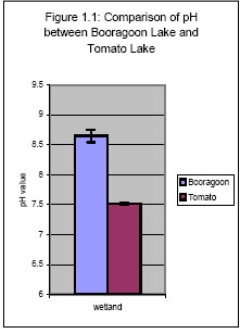
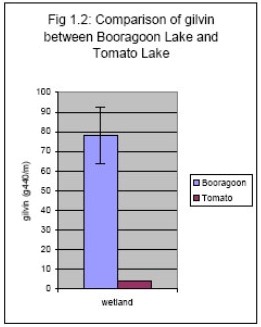
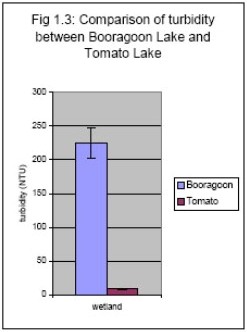
micro-Siemens per centimetre to total dissolved solids (TDS) in milligrams per litre falls within the 0 – 500 mg/L bracket, which denotes a freshwater wetland, Booragoon Lake is classed as a saline wetland, with a TDS measurement of over 3000 mg/L. Booragoon Lake also has the higher pH value (figure 1.1). While the waters of Tomato Lake can be considered close to neutral, the pH measured at Booragoon Lake suggests a basic water column. While the value for Tomato Lake falls within the ANZECC water quality guidelines for wetlands in the South West of Western Australia, as provided in Davis and Chambers (2004), Booragoon Lake is slightly higher than the recommended upper limit. While the guidelines acknowledge that for highly coloured wetlands, the pH value might be considerably lower than normal, the pH value in this case is beyond the upper limit. Booragoon Lake has substantially higher colour (figure 1.2) and turbidity (figure 1.3) in comparison to Tomato Lake, the latter being directly related to the high levels of chlorophyll a measured at the site.
 |
 |
 |
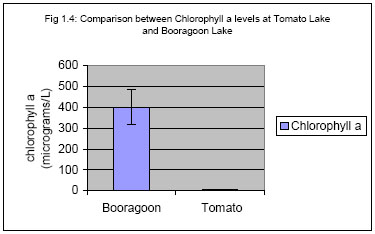
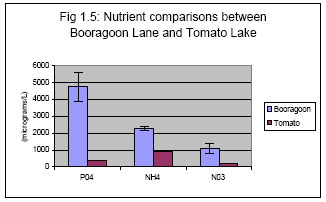
A chlorophyll a measurement of greater than 30 micrograms per litre is an indication of the presence of an algal bloom (Davis and Chambers, 2004). Therefore, as figure 1.4 shows, there is definite evidence of an algal bloom at Booragoon Lake, although not at Tomato Lake. This was supported by the visual observations taken at the time of sampling; the water at Booragoon was yellow and full of particulate matter. This result is in direct correlation with the higher nutrient levels found at Booragoon Lake (figure 1.5).
|
|
According to the guidelines provided in Davis and Chambers (2004), both wetland systems are nutrient enriched, but the level of enrichment at Booragoon Lake is extreme. This is supported by the presence of invertebrate taxa such as Corixidae at each site, as well as Chironomidae (found at Booragoon Lake) and Daphniidae (found at Tomato Lake in large quantities), all three of which are classed as indicator taxa for nutrient enrichment in wetlands. In addition to the indicator species, only 3 different invertebrate taxa were found at Booragoon Lake in total, whereas the average number of invertebrate and taxa found across the five sites at Tomato Lake was 5.6 (see proformas in appendix 1 for most abundant taxa). It was also found that both the exotic index and total percentage cover for fringing and terrestrial vegetation were greater for Booragoon Lake.
DISCUSSION:
In the study of wetland systems, it is important to address the ecology of the system as well as the physico-chemical aspects. While the hypothesis of this experiment addresses the physico-chemical parameters of the wetland system, the presence or absence of invertebrate taxa are good indications of overall water quality. Since both wetlands are urban systems, it is reasonable to assume that the natural ecological processes have been highly disturbed, and may be extreme at Tomato Lake. Both wetlands have been recipients of channelled storm water from surrounding areas for many years, and both have been modified in some way; especially at Tomato Lake.
The conductivity data collected in the course of this experiment does seem to obey the general trends observed in previous experiments. Tomato Lake contains water all year round, although considerably less in summer than in winter, and has a lower conductivity than Booragoon Lake which, over the course of an extended dry period has shrunk to little more than a puddle. Due to the extensive evaporation which has occurred at Booragoon Lake during this time, it would be expected that the concentration of ions left behind would be extreme, since the same quantity of ions would exist in substantially less water, and this proved to be the case. It is unclear why Tomato Lake exhibits such a low conductivity, as it would be expected that evaporation would also increase the conductivity in a similar way to, although not to the same extent as, Booragoon Lake. Human error may have been a factor in this result.
In previous studies, such as Brock and Shiel (1983) and Halse et al (1998), it has been found that invertebrate species diversity within a wetland decreases with increasing salinity; while conductivity is not the same as salinity, the two variables are closely correlated (Boulton and Brock, 1999). In this study, such a trend was observed, with greatest species diversity found at Tomato Lake where the conductivity was low and the lowest invertebrate species diversity found where the system was highly saline. However, since only two wetlands were analysed in this study, there is insufficient data to claim that species diversity is inversely related to conductivity at these sites.
The difference in pH between the wetlands can to some degree be related to the biological activity within the water column. At Booragoon Lake a bloom of microcystis covers the entire lake. The blue-green algae photosynthesise during the day, taking up carbon dioxide. The carbonate equilibrium causes the water column to respond to the removal of CO2 by using up H+ ions in order to create more CO2 to replace it. As a result, the pH of the water column rises, which explains why the pH at Booragoon is higher than at Tomato Lake, where there is little algal growth. It is not uncommon for highly coloured wetland systems to have a lower pH due to the presence of colouring agents such as humic and fulvic acids, however, this does not appear to be the case at Booragoon Lake.
The higher gilvin values recorded at Booragoon Lake are likely due, at least in part, to the presence of fringing vegetation at the Lake site. In particular, Melaleuca species’ may have contributed to the staining. The fringing vegetation at Tomato Lake is not established as it is at Booragoon. In 2002, a revegetation program was initiated which has seen part of the perimeter of the lake undergo replanting of native species.
However, since the project is so new, cannot be expected at this point to have had a large effect on the overall water quality of the lake. Also, a large part of the lake perimeter remains without fringing vegetation beyond grass and the occasional eucalypt. In terms of the wider ecology of the area, previous studies conducted by Davis et al (1993) and Growns et al (1992) have suggested that high colour levels leading to a lower overall pH, may lead to the loss of invertebrate diversity. While the relationship between high gilvin and low diversity of aquatic invertebrate taxa does appear in this study, it cannot be attributed to low pH, since the pH at Booragoon, the lake in question, is higher than that of Tomato Lake.
Turbidity at the Booragoon Lake was also much greater than at Tomato Lake, and this can be attributed in large part to the algal bloom occurring at Booragoon. Turbidity is a measure of suspended material in the water column. High turbidity can limit the amount of light available down the water column, thus reducing food availability and secondary productivity. The prolific bloom of cyanobacteria at Booragoon Lake reduced the photic zone to around 10cm. At Tomato Lake, there was a distinct absence of algal matter, and the waters were clear to the sediment. However, a higher than expected turbidity was achieved for this site, and was most likely due to the fact that the loosely packed sediments of the lake bed were very easily disturbed, and sampling undertaken in contact with the substrate caused a large cloud of sediment to rise through the water column which was very slow to resettle to the bottom. The turbidity measured for Tomato Lake was within the guidelines for a healthy wetland system as described in Davis and Chambers (2004).
The nutrient data for both lakes was different to what was expected. Both lakes were nutrient enriched, yet the nutrient levels at Booragoon Lake were extreme. It is suspected that the colony of Sacred Ibis, which roosts at the site, may be largely responsible. In comparison, the nutrient levels at Tomato Lake were lower than expected. Tomato Lake has been connected to the Belmont main drain for decades, and has 12 drains flowing into the lake. It was also the site for regular blooms of salvinia in the 1970s. It is reasonable to expect that most of the nutrients added to the system over time would have accumulated in the system, especially phosphorus which cannot escape into the atmosphere. The absence of aquatic vegetation means that nitrates and phosphate cannot have been removed from the system through biological uptake. Possibly, much of the nutrient material has been absorbed into the sediments and is bound there, thus removing it from the water column.
At Booragoon Lake, the fringing vegetation is not sufficient to counter the inflow of nutrients into the system. This means that with phosphate, ammonium, and nitrate in abundance, and with shallow and therefore warmer waters, conditions are ideal for an algal bloom. At Booragoon, the algal species microcystis covers the whole of the lake area and, combined with the high turbidity it causes and high colour in the water column, light is extremely limiting in the system. Deoxygenation occurs, causing the death of most other aquatic species, and as the algal mass is turned over, the nutrients cycle through the system, continually increasing and allowing for a sustained algal bloom. According to Growns et al (1992), highly enriched wetlands often have lower species diversity, and this is shown to be the case at Booragoon Lake. Only three aquatic invertebrate taxa were recorded, and the average found across the sites was 2.5. Not surprisingly the two most abundant taxa, Chironomidae and Corixidae, are classed as indicators for nutrient enrichment. The conditions at the lake are too harsh for most invertebrate taxa to be able to cope with. At Booragoon Lake, primary production is dominant in the system; at Tomato Lake the reverse is apparent, and secondary production (invertebrates) dominates the system.
While the results of this study supported the general hypothesis that a highly disturbed, yet well managed wetland system had better water quality than a relatively undisturbed wetland, the accuracy of results in the experiment may be improved in several ways. Firstly, the results of this study may be subject to a considerable level of human error as a result of inconsistencies in sampling methods (eg. how many times the sweep net made contact with the sediment), and when data collected by a number of different people is combined into a single data set, the combined values do not always agree. Secondly, an important physical parameter in wetland ecology is dissolved oxygen. If this study were to be undertaken again, it is recommended that this parameter may be useful in describing the interrelationships between the physical and biological components of the wetlands. Thirdly, an investigation into wetland water quality would likely be more accurate if a greater number of wetlands were sampled and compared, and if sampling had been undertaken on a wider timescale. This study has recorded data for a “snapshot in time” and analysis of a year’s data set may give some very different results and help to smooth such extremes as conductivity, which is highly concentrated in summer. Finally, in terms of the data that was obtained, a more accurate comparison may have been established if the sampling periods were close together. Between the time of sampling at Booragoon Lake and the time of sampling at Tomato Lake a number of weather events may have occurred, which might have altered the Booragoon data set.
CONCLUSION:
The results of this study indicate that water quality of highly disturbed wetlands can indeed be superior to that of less disturbed wetlands, provided they are well managed. Water quality parameters such as conductivity, pH, turbidity, gilvin nutrient concentration and chlorophyll a concentration are all higher for Booragoon Lake, supposedly a relativity undisturbed wetland. In comparison, the corresponding measurements taken at Tomato Lake fell within the loose guidelines set for wetlands on the Swan Coastal Plain, as set out in Davis and Chambers (2004), with the exception of nutrient concentration, which was somewhat lower than expected, although still indicative of a eutrophic wetland system. The analysis that better water quality existed at Tomato Lake was supported by the presence (or absence in the case of Booragoon Lake) of a diversity of wetlands invertebrates. While the hypothesis was supported, two data sets are really not sufficient, and a wider study involving a greater number of wetlands over a greater timescale would be needed to give endorsement of the hypothesis any real credibility.
REFERENCES:
• Boulton, A.J. and Brock, M.A., 1999, Australian Freshwater Ecology, Processes and Management, Gleneagles Publishing, South Australia.
• Bock, M.A. and Sheil, R.J., 1983, The composition of aquatic communities in saline wetlands in Western Australia, Hydrobiologia, 105, 77-84
• Chessman, B.C., Trayler, K.M., and Davis, J.A., 2002, Family- and species-level biotic indicies for macroinvertebrates of wetlands on the Swan Coastal Plain, Western Australia,
Marine and Freshwater Research, 53, 919-930
• Davis, J. and Chambers, J., 2004, ENV311 Management of Aquatic Systems Practical Manual, Murdoch University, Western Australia
• Davis, J.A., Roisch, R.S., Bradley, J.S., Growns, J.E., Schmidt, L.G. and Cheal, F., 1993, Wetland Classification on the Basis of Water Quality and Invertebrate Community Data, Wetlands of the Swan Coastal Plain, 6.
• Growns, J.E., Davis, J.A., Cheal, F., Schmidt, L.G., Roisch, R.S. and Bradley, S.J., 1992, Multivariate pattern analysis of wetland invertebrate communities and environmental variables in Western Australia, Australian Journal of Ecology, 17, 275-288.
• Hill, A.L., Semeniuk, C.A., Semeniuk, V., and Del Marco, A., 1996, Wetlands of the Swan Coastal Plain (Vol 2). Wetland Mapping, Classification and Evaluation; Water and Rivers Commission and Department of Environmental Protection; Perth, Australia
• Halse, S.A., Sheil, R.J. and Williams, W.D., 1998, Aquatic invertebrates of Lake Gregory, northwestern Australia, in relation to salinity and ionic composition, Hydrobiologia, 381, 15-29.
• Taman, L., MacShane, M., and de Haan, B.; 1997; “Tomato Lake Management Plan”; Native Environmental Systems, Western Australia
BIBLIOGRAPHY:
• Davis, J. and Chambers, J.; ENV 311 Management of Aquatic Systems lecture notes, 2004, accessed online via webCT.
• Verbal communication with Belmont City Council, April and May 2004